
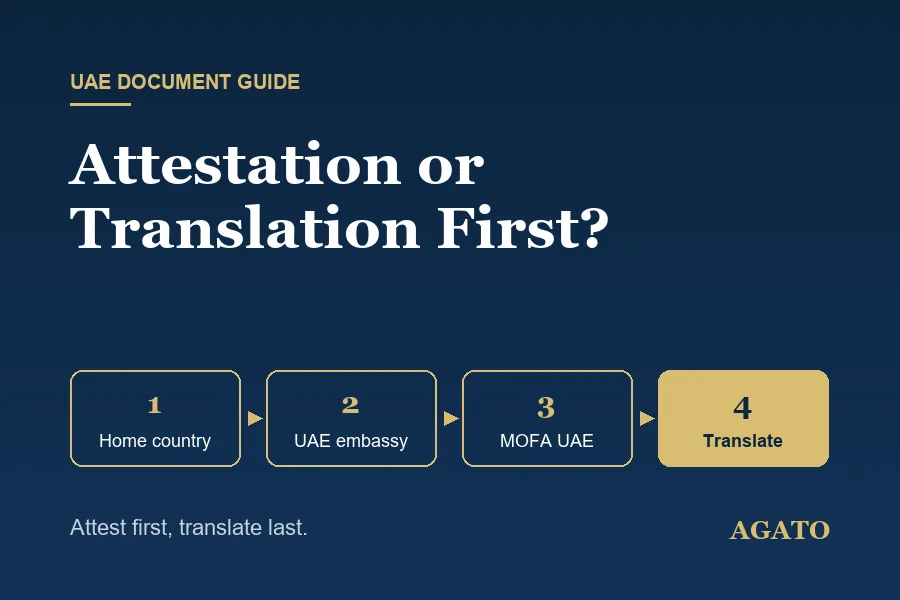
Short answer: attest first, translate last. Get every attestation stamp on your document first. That means the issuing country, the UAE embassy there, and MOFA in the UAE. Then give the attested document to an MOJ-licensed translator. The translation will cover the document and every stamp on it.
There is one exception. If your document is in a language other than Arabic or English, you may need a translation earlier in the chain. We explain this below.
Why attestation comes before translation
A legal translation covers the whole page. That includes the text, the seals, the signatures and every attestation stamp.
Say you translate your certificate today and the UAE embassy stamps it next week. The new stamp is not in your translation. The authority in the UAE compares the translation with the attested original, sees a stamp that was never translated, and sends it back. You pay for a second translation and lose days.
There is a second reason. MOFA does not need your document in Arabic. Its attestation page accepts originals in Arabic or English, or with a legally certified translation attached. The Arabic translation is usually needed later, by the authority you hand the document to, such as a court, a notary or a government department.
So the order follows the paperwork:
- Make the document valid (attestation).
- Make it readable for the authority that needs it (translation).
Find your situation
The right order depends on where your document comes from and where it is going. Most people fall into one of these three cases.
| Your situation | Translate when? |
|---|---|
| Foreign document in English, used in the UAE | Last, after MOFA UAE |
| Foreign document in another language, used in the UAE | Possibly twice: before the UAE embassy step, and again in the UAE if Arabic is needed |
| UAE document, used in another country | After MOFA UAE and any embassy step, following the destination country’s rules |
Case 1: An English document coming into the UAE
This is the most common case. Think of degrees, marriage certificates and birth certificates from India, Pakistan, the UK or the Philippines.
The order:
- Notary or issuing authority in the home country, if that country requires it.
- Foreign ministry of the home country.
- UAE embassy or consulate in the home country.
- MOFA UAE, applied for online through the MOFA website or app.
- Legal translation into Arabic by an MOJ-licensed translator, only if the receiving authority asks for Arabic.
Example: Your marriage certificate is from India and is in English. You need it for your wife’s residence visa. You get it attested in India, then by the UAE embassy in New Delhi, then by MOFA in the UAE. Only then do you order the Arabic translation. The translator translates the certificate and all three sets of stamps.
When you may not need a translation at all
MOFA accepts English documents. Some UAE entities also accept English. Others, such as the courts, work in Arabic. Before you pay for a translation, ask the authority receiving your document one question: “Do you need this in Arabic?”
Case 2: A document in Russian, Farsi, Chinese or another language
Here the rule bends a little. MOFA needs your document in Arabic or English, or with a legally certified translation attached. A Russian birth certificate on its own will not pass.
This means a translation often has to happen in the home country, before the UAE embassy stamps the document. Many UAE missions abroad set this as a condition. The UAE embassy in Serbia is a clear official example. It asks for a translation into English or Arabic by a local court translator before it attests.
The order:
- Translation into English or Arabic in the home country, if the UAE mission there requires it.
- Local attestation of the original and the translation, as the home country requires.
- UAE embassy in the home country.
- MOFA UAE.
- Arabic legal translation in the UAE, if the receiving authority needs Arabic and you only have English so far.
Example: You have a Russian birth certificate for your child’s school or visa file. First, check what the UAE embassy in Moscow asks for. If it wants an English translation, get that done in Russia. Complete the chain, then MOFA in the UAE. If the UAE authority wants Arabic, an MOJ-licensed translator in the UAE translates the full attested set.
Always check the UAE mission’s own page for the issuing country. Rules differ from country to country.
Case 3: A UAE document going abroad
Now the direction flips. You have an Arabic document issued in the UAE, such as a birth certificate, a court judgment or a power of attorney. You need it in another country.
The order:
- MOFA UAE attestation. When you apply, you choose the destination country. For some countries, MOFA can include the UAE embassy step in the same application.
- Embassy step, either the UAE embassy in the destination country or that country’s embassy in the UAE, depending on the option you chose.
- Translation into the destination country’s language, done where that country requires.
The last step is the one people get wrong. Some countries accept a UAE legal translation. Others want their own sworn or court translator. Serbia is an example of the second type. The translation is done by a Serbian court translator after the embassy seal.
Example: Your child was born in Dubai and the birth certificate is in Arabic. You need it for a passport application in your home country. Attest it at MOFA first, complete the embassy step, then check whether your home country accepts a translation from the UAE or wants its own.
Does an apostille replace UAE attestation?
No. The UAE is not a party to the 1961 Hague Apostille Convention. That means:
- An apostille from the UK, the US or any other member country does not replace the UAE embassy and MOFA steps. You still need the full chain.
- A UAE document cannot get an apostille inside the UAE. It goes through MOFA attestation instead.
If an agent offers you a “UAE apostille”, ask exactly what they mean. You can read more in our guide on whether apostilled documents need certified translation.
Digital attestation: faster, same order
MOFA now attests some UAE-issued digital documents online. The document must be an original digital PDF with a QR code, barcode or reference number from the issuing authority. A scan or a photo does not qualify.
Timing, from MOFA’s own service page:
| Route | Time |
|---|---|
| Digital attestation (UAE documents) | Within 2 hours, in official working hours |
| Courier route (UAE documents) | 1 to 3 business days |
| Courier route (documents outside the UAE) | Up to 7 business days |
The digital route saves days. It does not change the order. The attestation page is added to the end of the PDF, so the translation still comes after it.
Five mistakes that force a re-translation
- Translating before the UAE embassy stamp. The new stamp is missing from your translation, so it gets rejected.
- A name spelled differently from the passport. “Mohammed” on the passport and “Muhammad” on the translation is enough to stop a file. Give your translator a passport copy.
- Using a translator who is not MOJ-licensed. UAE authorities accept legal translations only from translators licensed by the Ministry of Justice.
- Laminated originals. MOFA does not accept laminated documents. Remove the lamination before you start, or get a fresh copy from the issuing authority.
- Photocopies instead of originals. Attestation is done on the original. A translation of an unattested photocopy has no use.
Checklist before you order a legal translation
Run through these five questions. If you can answer all of them, you are ready.
- Is every stamp in the chain on the document, including MOFA UAE?
- Which authority will receive it, and have they confirmed they need Arabic?
- Is the translator on the MOJ translators list?
- Does every name match the passport spelling exactly?
- Do you need a hard copy, a soft copy, or both?
Get your attested documents translated
AGATO Legal Translation has worked with individuals and companies in Dubai for decades. Our legal translations are done by MOJ-licensed translators in 120+ languages, and we translate every stamp on your attested document. Send us a scan of the attested document for a quote on our legal translation page.
If you still have stamps to collect, we handle that part too. Our attestation services cover MOFA, embassies and consulates, notarisation and the legal translation that follows.
Frequently asked questions
Do I need to attest my translated document?
For use inside the UAE, a legal translation by an MOJ-licensed translator usually needs no extra attestation. If the translation will be used in another country, that country may ask for it to be attested as well. Check with the authority that will receive it.
Does MOFA accept documents in English without an Arabic translation?
Yes. MOFA accepts original documents in Arabic or English. The Arabic translation is usually needed later by the authority you submit the document to, such as a court or a government department.
Can I translate my document before the UAE embassy attestation?
Only if the document is not in Arabic or English and the UAE mission in your country asks for a translation. Otherwise, wait. A translation done before the embassy stamp will not include that stamp and may be rejected.
Does the UAE accept an apostille instead of attestation?
No. The UAE is not a party to the Hague Apostille Convention. Foreign documents still need the UAE embassy and MOFA attestation, even if they carry an apostille.
How long does MOFA attestation take?
Digital attestation of eligible UAE documents takes up to 2 hours in working hours. The courier route takes 1 to 3 business days inside the UAE and up to 7 business days for documents outside the UAE.
How do I check if a translator is MOJ-licensed?
The UAE Ministry of Justice publishes a list of licensed legal translators on its website. Search for the translator or office name before you hand over your originals.